

Noongar Boodja Trust
What is the Noongar Boodja Trust?
The Noongar Boodja Trust is part of the governance structure for the South West Native Title Agreement between the Noongar People and the State of Western Australia.
The Noongar Boodja Trust will hold, maintain and grow the compensation paid by the State of Western Australia to the Noongar People under the Agreement.
These benefits will be applied to the six Noongar Regional Corporations and the Central Services Corporation who represent the Noongar Community under the Agreement.
Perpetual Trustee Company (Perpetual), as the first Noongar Boodja Trustee, welcomes the opportunity to act as trustee of the Noongar Boodja Trust and to work in partnership with Noongar People to realise the aspirations of the community that are intrinsically linked to Boodja (country), Kaarditjin (culture) and Moort (community).
The Noongar Boodja Trust will create an enduring legacy of self-determination for the Noongar People.
History of the South West Native Title Settlement
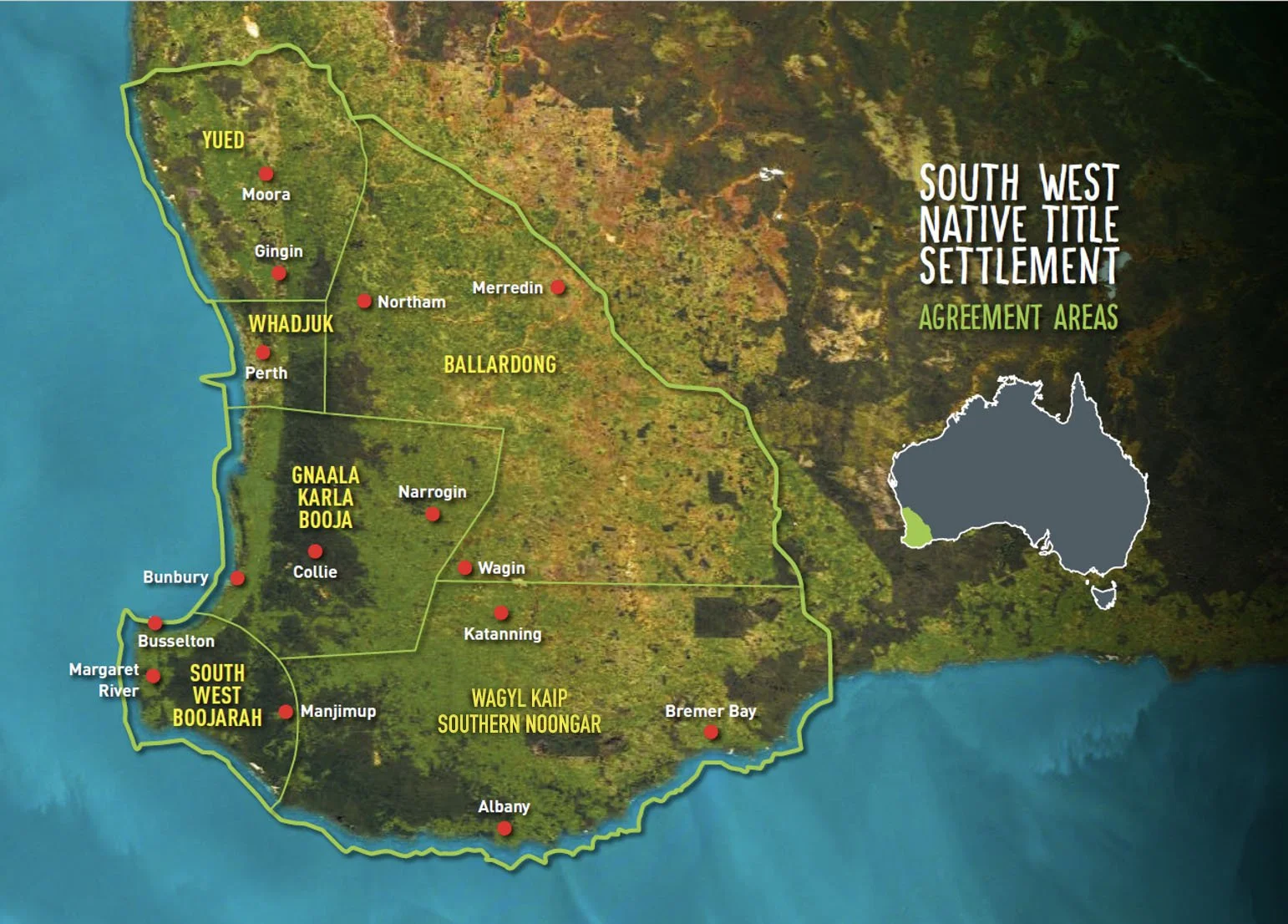
Noongars have lived in the southwest region of Western Australia for at least 45,000 years. For all these millennia, families of the Ballardong, Gnaala Karla, Boojarah, Wagyl Kaip, Whadjuk and Yued Peoples of the Noongar Nation prospered under the guidance of their Law and culture – an ancient and sophisticated framework revolving around a deep, inseparable and enduring connection to Boodja, knowledge and understandings embedded in Kaartdijin and relationships defined by Moort.
While the time since the establishment of the Swan River Colony represents less than 0.5 percent of Noongar history, as is the case for all Australian First Nations, colonisation had a profound impact on the Noongar. As settlers radiated out from colonial settlements, extensive areas of Boodja and landscape features and other artefacts important to Kaartdijin were destroyed, many irreparably; Noongars were dispossessed of resources; many Noongars were displaced, forced into indentured labour, incarcerated and in numerous incidences, murdered; and children were separated from families in the pursuit of eugenics-like assimilation policies. These were not just acts of the British Crown but also embedded in policies of progressive Western Australian Governments. In more recent decades, the intergenerational trauma resulting from these circumstances together with more insidious impacts of government policy have ensured that Noongars are over-represented in the lower bands of socio-economic status in Western Australia.
In 2015, almost a quarter of a century after the Mabo High Court Decision and implementation of the native title regime, six agreement groups collectively representing the Noongar Nation entered into agreements with the Western Australian Government, waiving future claims under the Native Title Act 1993 (Cth) in exchange for monetary compensation, fee simple, leasehold and management order interests over areas of Boodja and certain administrative and procedural rights pertaining Boodja. While nothing will ever fully compensate for the impact of colonisation on the Noongar, at a total estimated value of approximately AUD$1.2 billion, the Noongar Southwest Native Title Settlement (the ‘Settlement’) remains the largest compensation and settlement agreement between an Australian government and a First Nation.
However, the Settlement is much more than just a financial transaction. Combined with statutory recognition of Noongar People as the traditional owners of the south west of Western Australia - Noongar (Koorah, Nitja, Boordahwan) (Past, Present, Future) Recognition Act 2016 and Land Administration (South West Native Title Settlement) Act 2016 - - the arrangement between Noongar Nation and the Western Australian Government is widely recognised by legal experts as Australia’s first treaty-like agreement between an Australian First Nation and an Australian Government.
Taken as a whole, this treaty-like arrangement is significant recognition of the substantially elevated status of the Noongar Nation as holders of cultural identity, social and economic fabric and governance of south west of Western Australia– Noongars as a distinctive, important and visible part of Western Australia’s history and most importantly, its future.
To this end, the process of ‘Noongar nation building’ is a deliberate and determined effort to deploy the resources of the Settlement to ensure Noongar resource ownership and control, administrative and procedural rights, entrepreneurship, governance and advocacy are directed to achieving this outcome for Noongars and the State.
Notwithstanding that litigation-delayed completion of the 2015 agreements, the four years since the agreements were registered in 2021 has seen the Regional Corporations establish themselves as emerging institutions within the broader governance frameworks pertaining to their Boodja – driven by community elected boards and professional Noongar executive leadership they are reasserting kaartdijin and rights over Boodja in their regions, increasingly leveraging the resources of the Settlement to grow their capacity, confidently claiming normative rights under instruments such as the United Nations Declaration on the Rights of Indigenous Peoples (UNDRIP) and the Nagoya Protocol and collaborating to advocate for their people and the wider Noongar Nation.